


-
Share this page
Elastocapillary-based point-of-care device [Technology Offer]
The technology in a nutshell
New fluid-capture device based on elastocapillarity for point-of-care applications.
State of the art
The invention
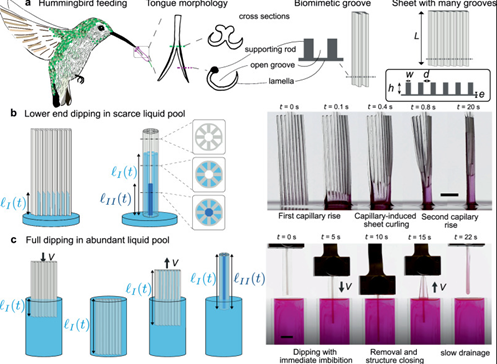
The invention is a fluid capture device that takes advantage of elastocapillary deformations. The hierarchical design of the device, that consists in vertical grooves stacked on an elastic sheet, enables a two-step sequential fluid capture. Each unit groove closes due to capillary forces when a wetting liquid penetrates, yielding the closure of the whole device in a tubular shape, where additional liquid is captured.
Key advantages of the technology
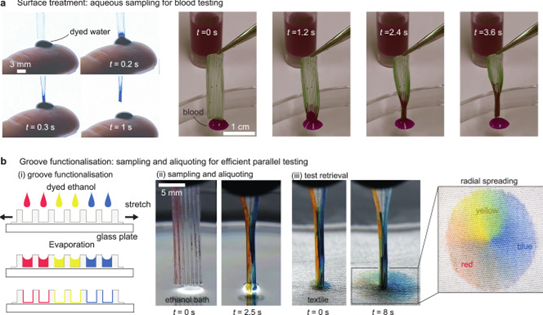
- Rapid and passive testing method allowing direct aliquoting and incubation with high surface-to-volume ratio, requiring no operator intervention or mixing
- Direct and fast readout
- Quick absorption enables viscosity estimation and hematocrit level assessment
- Requires only a minimal quantity of liquid (typically few microliters)
Technology readiness level

Potential applications
- Plasma viscosity measurement
- Hematocrit level assessment for rapid anemia detection
- Tear transfer system
- ABO blood typing
The Laboratory
This project is a collaboration between CHU Brugmann, the Non-linear Physical Chemistry Unit (NLPC) and the Transfers, Interfaces and Processes (TIPs) laboratory of the Université libre de Bruxelles (ULB). CHU Brugmann is a major public university hospital in Brussels affiliated with ULB, playing a key role in clinical research, medical training, and patient care. The TIPs laboratory focuses on experimental and theoretical microfluidics using advanced microfabrication techniques, whereas the NLPC unit is specialized in modelling self-organized processes to create desired structures spontaneously. This partnership ensures a strong link between fundamental and applied research and clinical applications.
Relevant publications
- Siéfert E, Scheid B, Brau F, Cappello J. Elastocapillary sequential fluid capture in hummingbird-inspired grooved sheets. Nat Commun. 2025 May 27;16(1):4913. doi: 10.1038/s41467-025-60203-8. PMID: 40425621; PMCID: PMC12117096.
Keywords
- Fluid Capture
- Point-of-care diagnostics
- Blood test
- Elastocapillarity
IP status
Priority date:
11/09/2024
Inventors
Fabian BRAU
Emmanuel SIEFERT
Jean CAPPELLO
Francis CORAZZA
Hannane EL KENZ
Contact
ULB Research Department
Joachim Ruol
Business developer
joachim.ruol@ulb.be