

-
Partager cette page
Self-healing sulfur concrete [Offre de technologie]
The technology in a nutshell
The technology offers an alternative solution to current sulfur concrete thanks to its crack detection and self-healing abilities provided by the addition of microwaveabsorbent and/or ferromagnetic fillers.
State of the art
Compared to Portland concrete, sulfur concrete currently used in the industry has many advantages: good chemical resistance, impermeability, fast curing, recyclability and construction without the addition of water. Nevertheless, it suffers from a certain weakness due to its low temperature resistance properties. The development of reliable and self-healing sulfur concrete is then a good alternative to existing less environmentally friendly solutions.
The invention
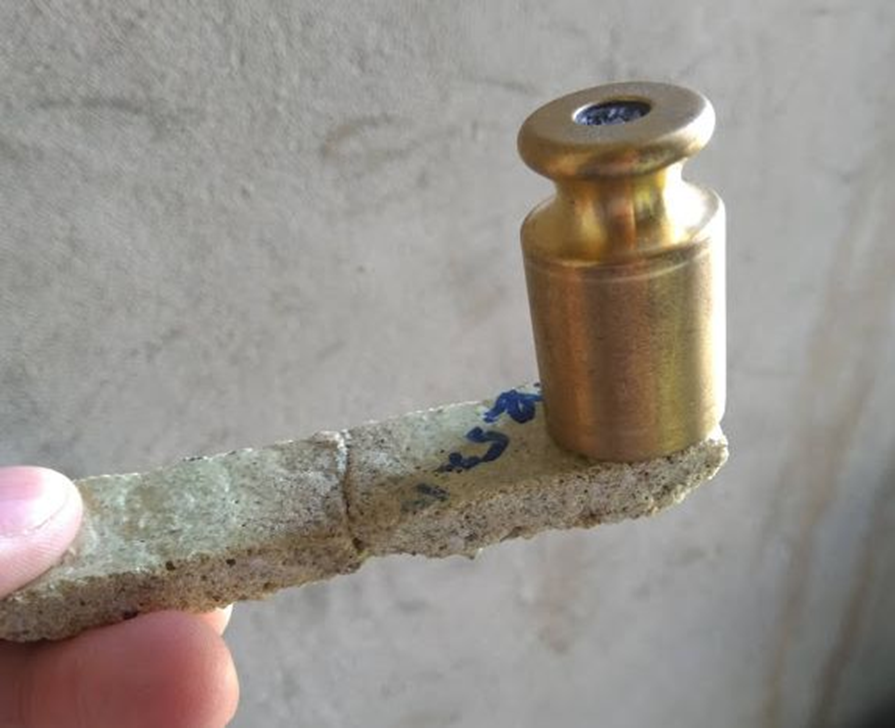
A new intelligent and self-healing sulfur concrete has been invented thanks to the addition of microwave-absorbent and/or ferromagnetic fillers allowing:
- Early microcracking detection
- Self-healing capabilities that can be activated by heating (microwave or induction).
It is designed to maintain its strength and can carry out localized repairs at high temperatures.
Potential applications
- Civil infrastructure
- Paving blocks, sleepers, sewer systems, channels, etc.
- Connection joints
- Spatial infrastructure
- Extra-terrestrial habitats
Key advantage of the technology
- Circular material for recasting potential
- High temperature resistance and local heating
- High acid and mechanical resistance
- Easy monitoring of potential crack formation
- Auto-repairing and self-healing of formed cracks.
Technology Readiness Level

The inventor
The team
The group on Sustainable Structural Design is part of the Civil Engineering Laboratory (LGC) of ULB-BATir and has large testing facilities (1,700 square meters) with up-to-date load and test equipment and data acquisition systems.
Keywords
- Self-healing sulfur mortar/concrete
- Electro-conductive and microwave-absorbing admixtures
- Microwave-absorbent and/or ferromagnetic filler
- Maintenance and repair
Collaboration type
- Licence agreement
- R&D collaboration
IP status
- Patent pending
- Priority application
EP25207767.2 - Date of priority: 9 October 2025
Inventors
- Didier SNOECK
Contact
ULB Research Department
Arnaud Quintens
Business developer
+32 (0)2 650 96 78
arnaud.quintens@ulb.be